Write Right - Jan Venolia 2001
Copyediting considerations
The tools of writing
If you get the form of things right, every peril can be tamed.
—Dick Francis
Publishers and large companies often have an in-house style guide to insure uniform handling of such matters as abbreviations, capitalization, and treatment of numbers. But if you’re on your own, the following guidelines will help.
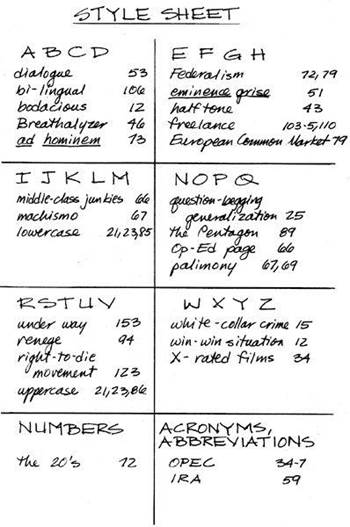
When acceptable usage is a matter of personal preference, consistency is the primary consideration. Make a style sheet to keep track of which words you’ve capitalized, how you treated numbers or compound words, and so on (see illustration on this page). Refer to it when you encounter a copyediting choice to see how you handled it previously. Consistency in these matters helps readers concentrate on the subject matter.
Abbreviations
The term abbreviation loosely covers three different condensed forms. An acronym is formed from first letters or parts of words and is pronounced as a word (NASA, OPEC). An initialism consists of the first letters of words and is pronounced letter by letter (SUV, NGO). An abbreviation is a shortened version of a word or phrase (Dept., Sec’y.).
Abbreviations take up less space and speed readers along—if they are in familiar territory. However, what is suitable for one audience may be inappropriate for another. Be aware of how much to expect of your readers. For example, the word versus is abbreviated as v. in legal citations, as vs. in headlines, and written out in text.
A few shortened forms have become words, their origins as acronyms all but forgotten (laser, modem, radar). Some words always appear in abbreviated form (COD, Mr., A.D., p.m.). Unless the shortened form is widely known, however, use the full name the first time it appears, followed in parentheses by the acronym or abbreviation you will use thereafter.
Choosing the correct article (a or an) to precede an acronym or initialism is important. Acronyms follow the usual rule for consonants and vowels: a precedes a consonant (a LAN user), an precedes a vowel (an OPEC meeting). But with initialisms, how the initial letter is pronounced determines which article to use. Certain consonants (F, H, L, M, N, R, S, and X) sound as if they begin with a vowel (f is pronounced “ef,” r is “ahr,” and so on). If an initialism begins with one of these consonants, an is the correct article (an SUV, an NGO).
Abbreviate addresses as follows:
✵ In an outside address (the address on the envelope), use the postal abbreviation of two capital letters and no period for a state or province. For example, write New York as NY (not N.Y.) and Quebec as PQ.
✵ Do not abbreviate streets or states in the inside address (the address typed on the first page of a letter). Although this rule is often ignored, observing it gives letters a more elegant appearance.
✵ Abbreviate compass points that follow street names.
Porter Street NW or Porter Street, NW
✵ Spell out compass points that precede street names.
1500 South H Street
One North Broadway
Abbreviate social titles.
Ms. is now an accepted title, comparable to Mr. Use Ms. in both business and social contexts unless you know that an individual prefers Miss or Mrs.
The formal plural of the abbreviation Mr. is Messrs. and of Mrs. is Mmes. Abbreviate other titles only with the person’s full name.
Gen. George S. Patton
Rev. Thomas Carlyle
Gov. Peter Stuyvesant
If the full name is not used, do not abbreviate the title
General Patton, not Gen. Patton
In general, abbreviate dates only in informal writing.
Feb. 14, 2010 14 Feb. 2010
With partial dates and in formal usage, write dates in full.
February 14, not Feb. 14
14 February, not 14 Feb.
Use ’s to form the plural of an abbreviation that has periods.
Seventy-three M.D.’s attended the meeting.
Abbreviate the following:
✵ United States and United Kingdom only when used as adjectives
U.S. ambassador U.K. foreign policy
Write out United States or United Kingdom when used as nouns.
The United States was represented by Vice President Martinez.
The United Kingdom has resisted converting to Eurodollars.
✵ The word figure only in a caption or parenthetical reference
(fig. 1)
Capitalization
Some people have the lazy habit of writing with all capital letters. But text written entirely in capitals is hard to read. Your job is to make the reader’s job easier, not harder. What’s more, emphasis is lost when everything is emphasized. Which of the following gets the idea across better?
I SAID NO! or I said NO!
The following rules will help you decide when to use capital letters.
Capitalize the first word of a sentence.
Humor is the shortest distance between two people.
—Victor Borge
The only exception to this rule is when the first word is a proper noun that begins with a lowercase letter (dePriest, von Braun, eNet). If possible, rewrite so that the problem noun no longer begins the sentence.
Capitalize the first word of a complete sentence following a colon.
The company has a new policy: Every employee has three weeks of paid vacation.
Caution: Radioactive material
Do not capitalize the word following a colon if it begins an incomplete statement.
The company has a new policy: three weeks of paid vacation.
Capitalize titles as follows:
✵ In titles of books, plays, television programs, and so on, capitalize the first and last words, plus all principal words. Do not capitalize articles or conjunctions. Capitalize prepositions if they consist of four or more letters, or if they are connected with a preceding verb.
Stop the World, I Want to Get Off
Customers Held Up by Gunmen
Situation Calls for Action
Peace Through Negotiation
✵ Capitalize both parts of a hyphenated word in a title or headline unless it is considered as one word or is a compound numeral.
Well-Known Actor Dies
Anti-inflation Measures Taken
Report of the Ninety-fifth Congressional District
Son-in-law’s Plea
✵ Capitalize personal titles only if they precede the name and are not separated by a comma.
Professor Reynolds
the treasurer, Will Peterson
Prime Minister Montgomery
Capitalize the following:
✵ Both full and shortened names of government agencies, bureaus, departments, or services
California Dept. of Corporations or Dept. of Corporations
Bureau of Pension Advocates
U.S. Treasury Department, or Treasury Department
Library of Congress
Law Reform Commission
Board of Supervisors
Home Office
Justice Department
Do not capitalize such words as government, federal, and administration except when part of the title of a specific entity.
The U.S. Government is the largest employer in the nation.
She hopes to work for the federal government.
✵ Points of the compass and regional terms when they refer to specific sections or when they are part of a precise descriptive title
the East |
Eastern Europe |
the Southern Hemisphere |
Vancouver’s West End |
Mid-Atlantic states |
North Pole |
the Orient |
the Outback |
Asia |
the Left Bank |
Do not capitalize these terms when they are suggesting direction or position.
central states |
western provinces |
south of town |
northern lights |
eastern Australia |
coastal districts |
Go west, young man.—John B.L. Soule
✵ Proper names but not descriptive words preceding them
city of Toronto, not City of Toronto
state of Vermont, not State of Vermont
✵ Abbreviations if the words they stand for are capitalized
M.D. Ph.D. M.P. J.D. Jr. a.m. p.m.
✵ Ethnic groups, factions, alliances, and political parties but not the word party unless it is part of the name
The Green Party is growing worldwide.
The Democratic party will be the first to hold its convention.
He spoke for the Korean community.
Use lowercase for political groupings other than parties.
She represents the centrist faction of the Newspaper Guild.
the left wing |
the right wing |
but |
the Left |
the Radical Right |
Capitalize African American, Caucasian, Hispanic, and Native American, but not blacks, whites, and slang words for the races.
With white writers there are a lot of gray areas. There are commercial writers, literary writers, genre writers. But if it’s black and it holds a pencil—that’s the category. —Wanda Coleman
Problems connected with designation of the races extend beyond questions of capitalization, however. Should you use Native American or American Indian, African American or black? Styles in ethnic terminology come and go, and not everyone agrees on any given term. Your best bet is probably to choose the term used by prominent individuals in the particular group.
✵ Captions and legends according to individual preference or in-house style
Please refer to figure 5.
The chart below shows wages by skill level (fig. 5).
In general, use lowercase for the words figure, table, and plate and their abbreviations when they appear in text. Capitalize these terms when they appear in captions.
Fig. 5—Wages by Skill Level
Do not capitalize the seasons.
We always look forward to the fall colors.
Italics
Having italic type is one of the joys of word processors. When used correctly, italics enhance the appearance of any document. If you don’t have italic type, use underlining.
Use italic type in the following cases:
✵ Titles of whole works, such as books, magazines, newspapers, movies, plays, and reports
Granta |
Romeo and Juliet |
Washington Post |
Gone with the Wind |
The Hite Report |
Harry Potter and the Sorcerer’s Stone |
Do not italicize the word the in the name of a newspaper unless it is part of the name.
Does the library subscribe to the Washington Post or The Cleveland Plain Dealer?
Use roman type and quotation marks for titles of articles, chapters, poems, essays, and similar short works.
“Trees”
“Self-Reliance,” by Ralph Waldo Emerson
Chapter 12, “The Human Use of Human Beings”
✵ Foreign words unless they are so widely used as to have become familiar
Black tie is de rigeur for the banquet.
The plane was en route to Algiers when they heard the news.
✵ For emphasis—occasionally
Woman was God’s second mistake.—Friedrich Nietzsche
The correct detail is rarely exactly what happened; the most truthful detail is what could have happened, or what should have.—John Irving
Each time I agree with myself, I write an essay. When I disagree with myself, I know that I’m pregnant with a short story or a novel.—Amos Oz
✵ To avoid confusion in cases where words are referred to as words, numbers as numbers, and letters as letters
The word alright should be written as two words, all right.
He wondered why the word tongue is feminine in so many languages.
The A’s should move to the front of the row, the B’s next, and so on.
If the word arse is read in a sentence, no matter how beautiful the sentence, the reader will react only to that word.—Jules Renard
✵ Short quotations when they stand alone, as at the beginning of a chapter
When you get to the end of your life, be sure you’re used up.—Edward Hoagland
Use roman type and quotation marks when the quotation is incorporated into text. (See this page.)
As Mark Twain once said, “Put all your eggs in one basket—and watch that basket.”
 Never use both quotation marks and italics for the same material.
✵ Punctuation marks that immediately follow an italicized word if they are part of the italicized expression.
Write Right! is a handy reference.
Numbers
When should you write numbers as words and when as figures? That depends on the nature of your writing. Nonetheless, certain conventions about numbers apply in all situations. Observe them to give your writing a professional polish.
Write numbers as words in the following cases:
✵ From 1 to 9 (in journalism, science, or business); from 1 to 99 (for literary writing)
There’s an old cowboy’s trick. The herd is coming through fast and one cowboy asks another how you estimate the number of cows so quickly. The other cowboy says: “It’s very easy. You just count the number of hooves and divide by four.”—David Mamet
All you need is fifty lucky breaks.—Walter Matthau
✵ At the beginning of a sentence
Three hours a day will produce as much as a man ought to write.—Anthony Trollope
Thirty percent of Americans may write poetry, but I doubt that thirty percent read poetry, even their own.
—David Lehman
✵ In round numbers or decades
several thousand people
between two and three hundred employees
in her eighties the Roaring Twenties
✵ In fractions standing alone or followed by of a or of an
one-fourth inch |
two-thirds of a cup |
two one-hundredths |
one-half of an apple |
I always try to write on the principle of the iceberg. There are seven-eighths of it under water for every part that shows.—Ernest Hemingway
✵ To clarify back-to-back modifiers
three 8-foot planks six 1/2-inch strips
Write numbers as figures in the following cases:
✵ For 10 and above (journalism, science, business); 100 and above (literary writing)
My efforts to cut out 50,000 words may sometimes result in my adding 75,000.—Thomas Wolfe
✵ When numbers both below and above 10 refer to the same general subject
5 of 20 employees
from 6th to 12th grade
✵ When they refer to parts of a book
Chapter 9 |
Figure 5 |
page 75 |
Table 1 |
✵ With dates and times
21st century 10 p.m. 5-year plan January 1, 2010
✵ When they precede units of time, measurement, or money
18 years old |
9 o’clock or 9:00 |
$1.50 |
75p |
2×4 inches |
$4 million |
¼-inch pipe |
10 yards |
3 hours 30 minutes 12 seconds |
NOTE: Units of time, measurement, and money do not affect the rule determining use of figures when numbers appear elsewhere in the sentence.
Wrong: The 3 students each collected $50.
Right: The three students each collected $50.
Spelling
It is a pity that Chaucer, who had geneyus, was so unedicated. He’s the wuss speller I know of.—Artemus Ward
Unless you’re a humorist like Artemus Ward, misspelling is not an asset. Misspelled words can mislead or confuse readers. They reflect poorly on you as a writer, suggesting carelessness elsewhere.
Spell-checkers help, but they aren’t the whole solution. They don’t pick up wrong words, particularly homophones (there, their, they’re), so they are no substitute for knowing how to spell.
If you consider yourself a bad speller, take a look at one of the books on spelling listed in the bibliography. By learning a few rules (forming plurals, adding suffixes) and by memorizing a few spelling demons (ei and ie words), you can graduate from the ranks of bad spellers. Use the list of frequently misspelled words that begins on this page as part of a spelling self-help program.
The most enjoyable way to improve spelling is to read good books. Notice how words look. You will absorb correct spellings indirectly, as if through your pores.
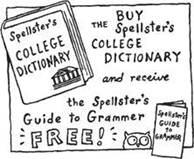
The person writing the copy for this ad should have made use of the dictionary!