Student's guide to writing college papers, Fourth edition - Kate L. Turabian 2010
Notes
Chicago style
Citing sources
18.1 Notes
18.1.1 When and How to Add Notes
18.1.1.1 Numbered Notes
18.1.1.2 Shortened Notes
18.1.1.3 Parenthetical References in the Text
18.1.2 Elements Common to All Notes
18.1.2.1 Author's Name
18.1.2.2 Title
18.1.2.3 Publication Facts
18.1.2.4 Page Numbers
18.1.3 Notes for Periodical Articles
18.1.4 Notes for Reference Works
18.1.5 Notes for Websites and Blogs
18.1.6 Notes for Books
18.1.6.1 Whole Books
18.1.6.2 Parts of Books
18.1.7 Notes for Citing Citations in a Source
18.2 Bibliography
18.2.1 Elements Common to All Bibliography Entries
18.2.1.1 Author's Name
18.2.1.2 Title
18.2.1.3 Publication Facts
18.2.2 Bibliography Entries for Periodical Articles
18.2.3 Bibliography Entries for Reference Works
18.2.4 Bibliography Entries for Websites and Blogs
18.2.5 Bibliography Entries for Books
18.2.5.1 Whole Books
18.2.5.2 Parts of Books
This chapter shows you how to use the Chicago notes-bibliography style. In Chicago style, you use numbered notes for the citations in your text. Whenever you use the words or ideas of a source, you mark the place in your text with a raised number called a superscript and give the information about the source in a correspondingly numbered note. You then collect all of the sources you have cited into an alphabetical listing called a bibliography. This list should also include any works that you did not cite but that influenced your thinking. In special cases, you may include all sources you consulted, even if you did not use them in any way; but ask your teacher before you do so.
The forms for notes and bibliography entries are different for different kinds of sources, but for each kind of source a note and bibliography entry are similar:
Note for Journal Article
1. Tim Hitchcock, “Begging on the Streets of Eighteenth-Century London,” Journal of British Studies 44, no. 3 ( July 2005): 489.
Bibliography Entry for Journal Article
Hitchcock, Tim. “Begging on the Streets of Eighteenth-Century London.” Journal of British Studies 44, no. 3 ( July 2005): 478—498.
Note for Book
2. Philip Ball, Bright Earth: Art and the Invention of Color (New York: Farrar, Straus and Giroux, 2001), 99.
Bibliography Entry for Book
Ball, Philip. Bright Earth: Art and the Invention of Color. New York: Farrar, Straus and Giroux, 2001.
Although they look similar, these forms vary in small but important details such as order of elements, punctuation, capitalization, and abbreviations. So be sure you use the right kind of example and pay close attention to these details. To help you avoid confusing the note form with the bibliography-entry form, we have listed them in different sections (18.1 Notes and 18.2 Bibliography).
How to Use This Chapter
This chapter presents models for the most common kinds of sources. You will find models for notes in section 18.1 and for bibliography entries in 18.2. Within each section, the models are listed by kind of source: articles, reference works, websites and blogs, and books. Follow these steps:
1. Find a model.
✵ Find the model that matches your kind of source. For instance, if you need to cite a scholarly journal article in an online database, find the example for “Online Journal.”
✵ Be certain that your source is in the same category as the example. If your source does not match any of the examples in this book, do not guess. Consult a more comprehensive guide, such as Kate. L. Turabian, A Manual for Writers of Research Papers, Theses, and Dissertations, 7th ed. (Chicago: University of Chicago Press, 2007).
2. Match the model.
✵ Create your citation by exactly matching the bibliographical information on your source to each detail in the model, point for point. Make sure that your note or bibliography entry corresponds to the model in every detail, including capitalization, abbreviations, punctuation, and spacing.
✵ If your source has multiple authors, consult the information on authors' names in section 18.1.2.1 (notes) or 18.2.1.1 (bibliography).
3. Adjust, but only if necessary.
✵ You may make reasonable small adjustments if your source is the same kind as a model but its bibliographic information is slightly different. For example, if the person who put together a book of collected material is called a “compiler” rather than an editor, you may use the form for an edited volume and use the word “compiler” or the abbreviation “comp.” wherever the example uses “editor” or “ed”: 68. Henry Jones, compiler, The Oxford Book of . . .
Many of you will use software packages that format citations for you automatically. You may let your software create a first draft of your citations, but do not trust it to produce the correct form. If you use an automatic citation builder, recheck each note and bibliography entry. Find the appropriate example and match it to the citation point by point. It is easy to miss small but important details when a citation is already formatted for you, so go slowly and be careful.
18.1 Notes
18.1.1 When and How to Add Notes
You must indicate in your text every place where you use the words or ideas of a source. In most cases, you should cite a source in a numbered note, with a corresponding number inserted in your text. The exact form of the note depends on the kind of source you cite: journal article, website, book, and so on. For sources you cite often, you can use parenthetical references.
For a quotation or paraphrase, insert the note number or parenthetical reference at the end of the quotation or at the end of the sentence that includes it:
The founding fathers' commitment to religious freedom was based on their commitment to the freedom of ideas. They were adamant that the “coercion of the laws” cannot apply to “the operations of the mind” in the way that they must apply to “the acts of the body.”3
For ideas or methods, insert the note number at the end of the sentence in which you first introduce or explain the borrowed material. Be sure to cite every source that influenced your thinking, even if you do not quote or paraphrase from it. A reader might think you're guilty of plagiarism if you seem to reflect the ideas of a text that you do not cite. (See chapter 10.)
Notes are called footnotes if you put them at the bottom of the page or endnotes if they are in a separate list at the end. Most readers find footnotes easier to use because they can see the text and the note at the same time, without turning to the end of the paper. Ask your teacher what she prefers, but if you have a choice, use footnotes.
18.1.1.1 Numbered Notes
Most citations in your paper should be in numbered notes. Use your word-processing software to insert into your text a raised number, or superscript, that directs readers to a correspondingly numbered note.
Most Americans think of homelessness as a recent development, but it has always been part of the American heritage. Beggars had long been common in London,1 which led early Americans to think of homeless beggars as a normal feature of city life. Of course, America's early cities . . .
1. Tim Hitchcock, “Begging on the Streets of Eighteenth-Century London,” Journal of British Studies 44, no. 3 ( July 2005): 489.
The superscript in your text must be after any punctuation:
NOT: . . . London1, which . . . BUT: . . . London,1 which . . .
Your word-processing software should format the note for you. If not, do this:
✵ Number each note with a superscript. (It is acceptable if your software uses a number followed by a period: 1. Tim Hitchcock, “Begging . . .”).
✵ Indent each note like a paragraph.
✵ Single-space notes with a blank line between notes.
✵ For footnotes, put a line between the body text and the first footnote on each page.
✵ For endnotes, list all notes starting on a new page after the text but before the bibliography; center the heading “Notes” at the top.
18.1.1.2 Shortened Notes
If you refer to the same source more than once, you can use a short form after the first note. The first note must give the full citation. After that, give enough information to identify the source, usually the author's last name and a word or two from the title. If you add page numbers, put a comma after the title and then the pages (but do not use p. or pp.).
Most Americans think of homelessness as a recent development, but it has always been part of the American heritage. Beggars had long been common in London,1 which led early Americans to think of homeless beggars as a normal feature of city life. Of course, America's early cities did not have extensive slums, which were the source of most of London's beggars.2 Nevertheless . . .
1. Tim Hitchcock, “Begging on the Streets of Eighteenth-Century London,” Journal of British Studies 44, no. 3 ( July 2005): 489.
2. Hitchcock, “Begging,” 491.
18.1.1.3 Parenthetical References in the Text
Although most citations should be in notes, you can use parenthetical references if you have several citations to the same source. This is common when your paper analyzes one or two texts, as in many literary, philosophical, or historical essays.
In these cases, the first reference to the source should be a complete note:
3. Thomas Jefferson, Notes on the State of Virginia, ed. William Peden (New York:
W. W. Norton & Company, 1954), 16.
After that, you can use a short parenthetical reference inserted into your text each time you cite this source. Give just enough information to match the reference to the full citation given in the note. In most cases, you should include only the author's last name and page number, separated by a comma:
The founding fathers' commitment to religious freedom was based on their commitment to the freedom of ideas. They were adamant that the “coercion of the laws” cannot apply to “the operations of the mind” in the way that they must apply to “the acts of the body” ( Jefferson, 159).
If you mention the author's name in your text, you can give just the page number in parentheses:
. . . their commitment to the freedom of ideas. As Thomas Jefferson put it, the “coercion of the laws” cannot apply to “the operations of the mind” in the way that they must apply to “the acts of the body” (159).
If, however, your paper cites two works by the same author, you need to give both the author's name and a keyword or two from the title so that readers will know which work you are citing:
. . . the “coercion of the laws” cannot apply to “the operations of the mind” in the way that they must apply to “the acts of the body” ( Jefferson, Notes, 159).
18.1.2 Elements Common to All Notes
When you create a note, you have to pay attention to the kind of source you are citing, because many elements of notes are different for different kinds of sources. But almost all notes consist of four basic elements—author's name, title of the work, publication facts, and page numbers.
18.1.2.1 Author's Name
The first element in a note is always the name of the author or authors. You should give the full name of the author exactly as it is shown in the source: use initials only if that's how the name appears. Do not include titles such as Sir, Saint, Sister, Reverend, Doctor, and so on. List all authors' names in regular order: first—middle—last. (Note: Authors are listed differently in bibliography entries; see 18.2.1.1.)
Single Author
4. Michael Pollan, The Omnivore's Dilemma . . .
5. J. K. Rowling, Harry Potter and . . .
Multiple Authors
If there is more than one author, list them in the order shown in the source. For three or more authors, put a comma between names and add and before the last name.
6. Steven D. Levitt and Stephen J. Dubner, Freakonomics . . .
7. Joyce Heatherton, James Fitzgilroy, and Jackson Hsu, Meteors and Mudslides . . .
If there is no author listed in the source, begin the note with the title of the work.
18.1.2.2 Title
Give the title exactly as it is shown in the source, including a subtitle if there is one. For articles and other short works, you will need both the article title and the title of the book, journal, or other work in which it occurs. If an online source does not have an obvious title, use the name of the site or any other reasonable replacement.
Capitalize titles headline style: capitalize the first and last words of the title and subtitle and all other words except articles (a, an, the), coordinate conjunctions (and, but, or, nor, for, so, yet), prepositions (of, in, at, above, under, and so forth), and the words to and as. If a title includes a subtitle, put a colon between the main title and the subtitle. With few exceptions, titles are set off in quotations marks or italics.
QUOTATION MARKS: ARTICLES, CHAPTERS, WEB PAGES, AND OTHER SHORT WORKS. Put the titles of short works that are part of longer ones in regular type, enclosed in quotation marks.
8. Tim Hitchcock, “Begging on the Streets of Eighteenth-Century London,” . . .
9. Charlotte M. Porter, “Artist-Naturalists in Florida,” Florida Museum of Natural History (website), accessed May 1, 2009, http://www.flmnh.ufl.edu/naturalists/.
ITALICS: BOOKS, JOURNALS, MAGAZINES, NEWSPAPERS, AND BLOGS. Put the titles of longer works in italics. If the title includes a title, put it in quotation marks and italics.
10. Thomas Jefferson, Notes on the State of Virginia, . . .
11. Tim Hitchcock, “Begging on the Streets of Eighteenth-Century London,” Journal of British Studies . . .
12. John E. Sitter, The Poetry of Pope's “Dunciad,” . . .
18.1.2.3 Publication Facts
In addition to the author's name and title of the work, a note usually includes facts that identify where and when a source was published. Publication facts vary from one kind of source to another, so check each model carefully.
For online sources, you must also include the date you accessed the source and a complete online address or URL (uniform resource locator). In most cases, you should include the URL exactly as it appears in your browser bar, even if it is very long.
13. . . . Florida Museum of Natural History (website), accessed May 1, 2009, http://www.flmnh.ufl.edu/naturalists/.
Most word processors will not break URLs if they spill over a line, but you can force a line break after a slash (/). If that still leaves a mostly empty line, you can force a break before a period, equal sign, or other punctuation.
18.1.2.4 Page Numbers
If you cite a specific passage in a source, you must indicate where readers can find that passage, usually by adding a page number. The page number (or numbers) may be preceded by either a comma or a colon, depending on the type of source. Do not include the word page or the abbreviations p. or pp. before the number.
14. Tim Hitchcock, “Begging on the Streets of Eighteenth-Century London,” Journal of British Studies 44, no. 3 ( July 2005): 489.
If you cite a range of pages, include all the digits in both numbers: do not abbreviate the second (not 127—32).
15. Philip Ball, Bright Earth: Art and the Invention of Color (New York: Farrar, Straus and Giroux, 2001), 98—99.
If you cite material from a table or lines from a poem, use the word table or line(s) and an identifying number(s).
16. Kenneth T. Jackson, Crabgrass Frontier: The Suburbanization of the United States (New York: Oxford University Press, 1985), table 1.
17. Ogden Nash, “Song for Ditherers,” lines 1—4.
Many online sources do not have page numbers. If the source has a label for the section you quote, a heading, or a numbered paragraph, then use that as a locator. Otherwise, you can skip this element.
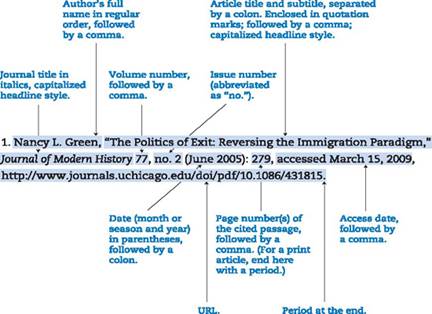
18.1.3 Notes for Periodical Articles
Most of the articles you will consult will be found in periodicals—journals, magazines, newspapers, and other works published at periodic intervals in print form, online, or both.
✵ Journals are scholarly or professional periodicals written for experts and available primarily in academic libraries. Journals often include the word journal in their titles ( Journal of Modern History), but not always (Postmodern Culture).
✵ Magazines are not scholarly publications; they are designed for more general readers in both their content and their availability outside of academic settings. If you are unsure whether a periodical is a journal or a magazine, see whether its articles include citations; if so, treat it as a journal.
✵ Newspapers are generally daily or weekly publications whose articles are closely tied to recent events.
The Basic Pattern
Print Journal
If a journal lists both a volume and issue number, include both; list the date as it is printed on the journal (year, month + year, or season + year).
18. Ann Grodzins Gold, “Grains of Truth: Shifting Hierarchies of Food and Grace in Three Rajasthani Tales,” History of Religions 38, no. 2 (November 1998): 150—151.
19. Garrett Cullity, “Decisions, Reasons, and Rationality,” Ethics 119 (October 2008): 64.
20. Joshua Brown, “Historians and Photography,” American Art 21, no. 3 (Fall 2007): 9—10.
Online Journal
If an online article has numbered pages, cite them. If not, look for headings, section numbers, or paragraph numbers. Otherwise, do not cite pages.
21. Jeremy Adelman, “An Age of Imperial Revolutions,” American Historical Review 113, no. 2 (April 2008), accessed September 15, 2008, http://www.journals.uchicago.edu/doi/full/10.1086/ahr.113.2.319.
22. Alan Bass, “The Mystery of Sex and the Mystery of Time: An Integration of Some Psychoanalytic and Philosophical Perspectives,” Postmodern Culture 18, no. 1 (2007), accessed January 7, 2008, http://muse.jhu.edu/login?uri=/journals/postmodern_culture/v018/x.1.bass.html.
If an online article lists what it calls a “stable URL” or “permanent URL,” use that instead of the URL in your browser bar.
23. Frank P. Whitney, “The Six-Year High School in Cleveland,” School Review 37, no. 4 (1929): 70, accessed January 31, 2009, http://www.jstor.org/stable/1078814.
Print Magazine
24. William Langewiesche, “Rules of Engagement,” Vanity Fair, November 2006, 50.
If the article is part of a “department” (a recurring section with the same title in each issue), add the department name in regular type without quotation marks between the article and magazine titles.
25. Hendrik Hertzberg,“Follow the Leaders,”Talk of the Town, New Yorker, December 10, 2007, 41.
Online Magazine
If an online article has numbered pages, cite them. If not, look for headings, section numbers, or paragraph numbers. Otherwise, do not cite pages.
26. Stefan Theil, “In California, Green Means Growth,” Newsweek, March 2, 2009, accessed April 24, 2009, http://www.newsweek.com/id/185792.
27. Nancy Goldstein, “The Economy Is a Feminist Issue,” Salon.com, February 20, 2009, accessed February 26, 2009, http://www.salon.com/mwt/broadsheet/feature/2009/02/20/women_economy/index.html.
Print Newspaper
Omit page references for newspaper articles.
28. Lisa Guernsey,“Rewards for Students under a Microscope,” New York Times, March 3, 2009.
Online Newspaper
29. Lisa Guernsey,“Rewards for Students under a Microscope,” New York Times, March 3, 2009, accessed March 9, 2009, http://www.nytimes.com/2009/03/03/health/03rewa.html.
18.1.4 Notes for Reference Works
Reference works are sources such as encyclopedias and dictionaries; their entries usually do not have authors. (Cite an entry with an author as you would a chapter of a book; see 18.1.6.2.) If a reference work is arranged alphabetically, do not cite page numbers; list the entry in quotation marks, preceded by “s.v.” (for the Latin sub verbo, or “under the word”). If you list more than one entry in the same note, use “s.vv.”
Print Encyclopedia
If an encyclopedia has an edition number, give it.
30. Encyclopaedia Britannica, 15th ed., s.v. “Sibelius, Jean.”
Online Encyclopedia
31. Wikipedia, s.v. “Martin Luther King, Jr.,” accessed January 15, 2008, http://en.wikipedia.org/wiki/Martin_luther_king.
Print Dictionary
If a dictionary has an edition number, give it.
32. Oxford English Dictionary, 2nd ed., s.v. “hoot(e)nanny, hootananny.”
33. Dictionary of American Biography, s.v. “Wadsworth, Jeremiah.”
Online Dictionary
34. Merriam-Webster OnLine, s.v. “mondegreen,” accessed September 19, 2008, http://www.merriam-webster.com/dictionary/mondegreen.
18.1.5 Notes for Websites and Blogs
You must cite all material you find on the Internet, even if it is not published by a journal, magazine, or newspaper. In a note, you should not cite a website as a whole (www.whitehouse.gov); cite the specific document or web page that you consulted (www.whitehouse.gov/agenda/energy_and_environment/). Similarly, do not cite an entire blog in a note, but the particular posting or comment that you use in your paper.
Web Page
Websites are unpredictable, so you may have to improvise, but as much as possible include the same kind of information you need for other online publications:
✵ author, if any
✵ web page title (in quotation marks)
✵ website title, if any (in italics)
✵ sponsoring organization, if any (in regular type)
✵ access date and URL
35. Charlotte M. Porter, “Mark Catesby's Audience and Patrons,” Florida Naturalists (website), Florida Museum of Natural History, accessed May 1, 2009, http://www.flmnh.ufl.edu/naturalists/catesby01.htm.
36. “Code of Ethics,” City of Los Angeles (website), accessed March 13, 2008, http://www.lacity.org/ita/urldoc2540.pdf.
37. “Biography,” The Charles Chestnut Digital Archive (website), ed. Stephanie P. Browner, accessed March 10, 2009, http://www.chesnuttarchive.org/classroom/biography.html.
Blog Entry
Blog entries have relatively predictable bibliographical information:
✵ author
✵ title of posting (in quotation marks)
✵ title of blog (in italics)
✵ date of posting
✵ access date and URL
38. Rhian Ellis, “Squatters' Rights,” Ward Six (blog), June 30, 2008, accessed August 1, 2008, http://wardsix.blogspot.com/2008/06/squatters-rights.html.
Web Page or Blog Comment
To cite a comment on a blog entry, begin with the name (or pseudonym) of the commenter, the title (if any), the date and time of the comment, and the words “comment on” followed by the standard entry for a blog entry or web page.
39. AC, July 1, 2008 (10:18 a.m.), comment on Rhian Ellis, “Squatters' Rights,” Ward Six (blog), June 30, 2008, accessed August 1, 2008, http://wardsix.blogspot.com/2008/06/squatters-rights.html.
40. Philogenes,“Shocked, Shocked, I Tell You,” March 16, 2009 (1:00 p.m.), comment on “Composition, Overcrowded,” Inside Higher Ed (website), March 16, 2009, accessed March 17, 2009, http://www.insidehighered.com/news/2009/03/16/comp#Comments.
18.1.6 Notes for Books
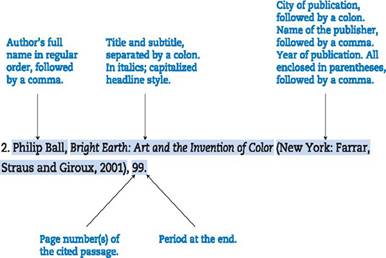
The Basic Pattern
18.1.6.1 Whole Books
Print Book
41. Newton N. Minow and Craig L. LaMay, Inside the Presidential Debates: Their Improbable Past and Promising Future (Chicago: University of Chicago Press, 2008), 54.
If the book is produced by an organization rather than a person, list the organization as the author:
42. World Health Organization, Health and Economic Development in South-Eastern Europe (Geneva: World Health Organization, 2006), 92.
Book in Electronic Reader Format
Use the publication date of the e-book edition, and identify the e-book format. Do not use page numbers, but use chapters instead (abbreviate as “chap.”).
43. Jane Austen, Pride and Prejudice (New York: Penguin Classics, 2007), Kindle edition, chap. 23.
Online Book
Most online books have page numbers. If not, identify the pages by section or chapter number.
44. Walt Whitman, Leaves of Grass (New York: self-published, 1855), 22, accessed November 22, 2009, http://www.whitmanarchive.org/published/LG/1855/whole.html.
Edited or Translated Book
If a book has an editor or translator but no author, put the editor or translator in place of the author, followed by the abbreviation “ed.” or “trans.”
45. Glenn Young, ed., The Best American Short Plays, 2002—2003 (New York: Applause, 2007), 94.
46. Theodore Silverstein, trans., Sir Gawain and the Green Knight (Chicago: University of Chicago Press, 1974), 34.
If a book has an author as well as an editor or a translator, identify the editor or translator between the title and the publication facts.
47. Yves Bonnefoy, New and Selected Poems, ed. John Naughton and Anthony Rudolf (Chicago: University of Chicago Press, 1995), 64.
48. Georges Feydeau, Four Farces by Georges Feydeau, trans. Norman R. Shapiro (Chicago: University of Chicago Press, 1970), 122.
Revised Edition
If you consult a book labeled as a “revised” edition or a “second” (or subsequent) edition, place this information between the title and the publication facts, using abbreviations.
49. Karen V. Harper-Dorton and Martin Herbert, Working with Children, Adolescents, and Their Families, 3rd ed. (Chicago: Lyceum Books, 2002), 43.
50. Florence Babb, Between Field and Cooking Pot: The Political Economy of Market-women in Peru, rev. ed. (Austin: University of Texas Press, 1989), 199.
Multivolume Work
If you cite one book from a group of books with the same title (known as a multivolume work), indicate the volume number immediately before the page number, with the two numbers separated by a colon. Do not include the word “volume” or the abbreviation “vol.”
51. Muriel St. Clare Byrne, ed., The Lisle Letters, 6 vols. (Chicago: University of Chicago Press, 1981), 4:243.
If the volume you cite has a different title from that of the whole group, give the volume title first, followed by “vol. X of ” the group as a whole.
52. Jaroslav Pelikan, Christian Doctrine and Modern Culture (since 1700), vol. 5 of The Christian Tradition: A History of the Development of Doctrine (Chicago: University of Chicago Press, 1989), 16.
18.1.6.2 Parts of Books
Chapter in an Edited Book
If a book consists of chapters written by several different authors, cite the specific chapter you borrowed from.
53. Elizabeth F. L. Ellet, “By Rail and Stage to Galena,” in Prairie State: Impressions of Illinois, 1673—1967, by Travelers and Other Observers, ed. Paul M. Angle (Chicago: University of Chicago Press, 1968), 275.
Introduction, Preface, or Afterword
If someone other than the author has written a supplemental part of a book, such as an introduction, preface, afterword, or epilogue, cite it separately. Do not capitalize a generic title such as “introduction”; put it in regular type, without quotation marks.
54. Francine Prose, introduction to Word Court: Wherein Verbal Virtue Is Rewarded, Crimes against the Language Are Punished, and Poetic Justice Is Done, by Barbara Wallraff (New York: Harcourt, 2000), 9.
Letter in a Collection
55. Adams to Charles Milnes Gaskell, London, 30 March 1868, in Letters of Henry Adams, 1858—1891, ed. Worthington Chauncey Ford (Boston: Houghton Mifflin, 1930), 141.
Short Story or Poem in a Collection
Put the titles of these works in regular type with quotation marks except for very long poems, whose titles are italicized.
56. Deborah Eisenberg, “Someone to Talk To,” in All around Atlantis (New York: Farrar, Straus and Giroux, 1997), 61—92.
57. Seamus Heaney, “To George Seferis in the Underworld,” in District and Circle: Poems (New York: Farrar, Straus and Giroux, 2006), 23.
58. Michael Wigglesworth, excerpt from The Day of Doom, in The New Anthology of American Poetry: Traditions and Revolutions, Beginnings to 1900, ed. Steven Gould Axelrod, Camille Roman, and Thomas Travisano (New Brunswick, NJ: Rutgers University Press, 2003), 71.
18.1.7 Notes for Citing Citations in a Source
When you find useful information quoted or reported in a secondary or tertiary source, you should always try to locate the original source. If you cannot, you must cite both the original source and the one you actually used. Cite the original source completely, including the page number(s), then add “quoted in” (for quotations) or “reported in” (for other borrowings), followed by the complete citation for the source you consulted. Put both sources in your bibliography.
59. Louis Zukofsky, “Sincerity and Objectification,” Poetry 37 (February 1931): 269, quoted in Bonnie Costello, Marianne Moore: Imaginary Possessions (Cambridge, MA: Harvard University Press, 1981), 78.