The word snoop - Ursula Dubosarsky 2009
Plurals
Why is english so strange?
It’s not just spelling that makes English strange, though. What about plurals?
Plural means more than one. (I know, I know, you knew that already!) In English, when you want to make a word plural you just add an s. So a cat becomes cats, sausage becomes sausages, and—
But wait a minute. What about mouse? You can’t say two mouses. And what about sheep? There’s no such thing as many sheeps. Or three womans—and what about one knife and two knives? And one hero and two heroes. What’s that all about?
You’re right. It’s not always just an s. (There they go again, those dastardly exceptions . . .)
The Anglo-Saxons (remember them?), who began the English language, had quite a few ways of making a plural. For some words they added es, but for others they added an r or an en, or sometimes both. This is why today we still say child and children, and ox and oxen. They also had plurals that changed the sound inside the word instead of at the end, like man and men, foot and feet, tooth and teeth. Then there were words in Anglo-Saxon that didn’t change at all in the plural, like sheep and fish. And as for things like leaf and leaves? Well, in Anglo-Saxon, an f at the end of a word sounded like v anyway, and over time somehow the v made its way into the plural spelling.
Now, I’m sure you haven’t forgotten William-the-Conqueror-who-came-to-England-from- France-and-conquered-it-very-quickly. (Um, have you?) Anyway, as I was telling you, William and all his friends and relatives (there were lots of them) spoke French, and in French usually they just added an s to make a plural. This fine idea became popular in English as well, and is now the most common way to do it.
So, there are the Anglo-Saxon plurals and the French plurals, but there’s yet another type of plural in English that you may have noticed—the Latin and Greek plurals. During the Renaissance (from the fourteenth to the sixteenth century), educated people felt that the ancient languages of Latin and Greek were really the best of all. So they started to throw Latin and Greek words into English—words like crisis or radius. But then, what if they wanted to mention more than one crisis or radius? Crisis es and radiuses sounds terrible (especially if you happen to have a lisp). So instead they kept the Latin and Greek ways of making plurals for those sorts of words—crises and radii.
That explains at least where some of these plurals come from. But, like the funny spellings, it doesn’t explain why we don’t just change it all to something easier. I mean, there are languages like Japanese and Chinese, spoken by millions and millions of people, that don’t even have plurals and it doesn’t bother anyone.
Well, I suppose in the end, language, like history, is made by human beings. And human beings are so hopelessly different and disorganized, they can never quite agree on anything. They’re only human, after all. (Sigh.)
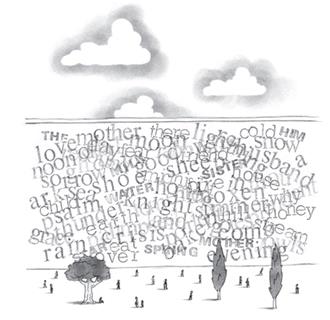
Still, maybe there’s something special about having these crazy plurals, and even crazier spellings. I sometimes think English is like a big old wall that people have been scribbling on for centuries. How sad it would be if someone came along and just sloshed a huge can of paint over the top of it, and everything disappeared and all we had left was a nice, clean wall . . .