PSAT/NMSQT Prep 2020 - Princeton Review 2020
The method for PSAT math questions
Psat math
Learning Objectives
After completing this chapter, you will be able to:
· Efficiently apply the Math Method to PSAT Math questions
How to Do PSAT Math
PSAT Math questions can seem more difficult than they actually are, especially when you are working under time pressure. The method we are about to describe will help you answer PSAT questions, whether you are comfortable with the math content or not. This method is designed to give you the confidence you need to get the right answers on the PSAT by helping you think through each question logically, one piece at a time.
Take a look at this question and take a minute to think about how you would attack it if you saw it on test day:
1. The Collins Library is one of four public libraries in Madison County. According to data maintained by the county’s public library system, 58% of the 15,000 books in Collins Library are fiction titles. If Collins Library is representative of the public libraries in Madison County with regard to the number of fiction vs. nonfiction titles, and the average number of books per public library in Madison County is 15,000, then which of the following is the best estimate of the total number of nonfiction titles held by public libraries in Madison County?
1. 8,700
2. 25,200
3. 34,800
4. 60,000
Many test takers will see a question like this and panic. Others will waste a great deal of time reading and rereading without a clear goal. You want to avoid both of those outcomes.
Start by defining clearly for yourself what the question is actually asking. What do the answer choices represent? In this question, they represent the number of nonfiction books in all the public libraries in Madison County.
Next, examine the information that you have and organize it logically. The question asks about the number of nonfiction books. Okay, then what information do you have about numbers of books? You know that 58% of the 15,000 books in Collins Library are fiction. That’s the opposite of nonfiction. You can deduce that 100% − 58% = 42% of the 15,000 books in Collins Library are nonfiction books.
Now, make a strategic decision about how to proceed. The answer choices are far apart, so you might consider rounding 42% to  and estimating. However, this question appears on the calculator section, and it’s a quick calculation. Let’s say that you decide to use your calculator. Plug the numbers into your calculator and jot down what you know so far:

The question asks for the number of nonfiction books in Madison County, so hunt for information tying Collins Library to Madison County. You’re told that the average number of books per public library in Madison County is 15,000, which is identical to the number of books in Collins Library, and that Collins Library is “representative” of the libraries in Madison County. Translation: what is true for Collins Library is also true for all public libraries in Madison County. You also know that there are four public libraries in Madison County. You can deduce that the number of nonfiction books in Collins Library (6,300) times the total number of public libraries in Madison County (4) will give you the number of nonfiction books in all of Madison County. Plug that into your calculator:

Finally, confirm that you answered the right question: you want the number of nonfiction books in all public libraries in Madison County. That’s what you calculated, so you’re done; the correct answer is (B).
Here are the steps of the method we just used:
|
Method for PSAT Math Questions |
|
|
Step 1. |
State what the question is asking |
|
Step 2. |
Examine the given information |
|
Step 3. |
Choose your approach |
|
Step 4. |
Confirm that you answered the right question |
You can think of these steps as a series of questions to ask yourself: What do they want? What are they giving me to work with? How should I approach this? Did I answer the right question?
Not all PSAT Math questions will require time spent on all of the steps. The question above, because it is a word problem, required a fair amount of analysis in steps 1 and 2, but choosing an approach (step 3) was straightforward; the calculations were quick to do on a calculator, so there was no need to estimate. Other questions will require very little thought in steps 1 and 2, but will benefit from a careful strategy decision in step 3. Step 4 is always quick, but you should always do it: just make sure you answered the question that was actually asked before you bubble in your response. Doing so will save you from speed mistakes on questions that you know how to do and should be getting credit for.
There are several approaches you can choose from in step 3: doing the traditional math, as we did in the question above; Picking Numbers; Backsolving; estimating; or taking a strategic guess. In the next two examples, you’ll see Picking Numbers and Backsolving in action.
Here’s another example. This one is not a word problem, so steps 1 and 2 require negligible mental energy, but pay attention when you get to step 3:
1. Which of the following expressions is equivalent to 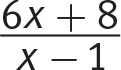 ?
?
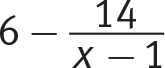
1. 
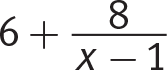
2. 
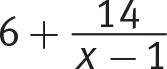
3. 
4. 
Step 1. What do they want? An expression equivalent to 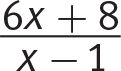 .
.
Step 2. What do they give you? Only the expression 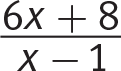 .
.
Step 3. What approach will you use?
Here’s where it gets interesting. The creator of this question may be expecting you to use polynomial long division to solve, and we’ll cover that technique in the online appendix included with this book because you may want to have it in your arsenal. But if you don’t know how to do polynomial long division, there’s no need to panic. You could use an alternate approach called Picking Numbers that will work just as well: choose a number to substitute for x in the question, then substitute the same number in for x in the choices and see which one matches. Like this:
Pick a small number for x, say 2. When x = 2, the original expression becomes the following:

Now, plug x = 2 into the choices:
(A) 
Not 20, so eliminate (A).
(B) 
Eliminate (B).
(C) 
This is a match. When using Picking Numbers, it is possible that another answer choice can produce the same result, so check (D) to be sure there isn’t another match when x = 2. (If there is, go back and pick another number to distinguish between the choices that match.)
(D) 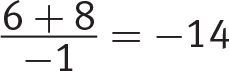
Eliminate (D).
Step 4. Did you solve for the right thing? You found the equivalent expression, so yes. Only (C) is a match, and therefore it is correct.
When picking numbers, use numbers that are permissible and manageable. That is, use numbers that are allowed by the stipulations of the question and that are easy to work with. In this question, you could have picked any real number because x was not defined as positive, negative, odd, even, a fraction, etc. A small positive integer is usually the best choice in this situation. In other questions, other kinds of numbers may be more manageable. For example, in percents questions, 100 is typically a smart number to pick.
Try one more:
1. A child is arranging plates of apples to serve at a party. If the child places 6 apples on each plate, there will be 5 apples left over. In order to place 7 apples on each plate, with no apples left over, 5 more apples are needed. How many apples does the child have to arrange?
1. 32
2. 41
3. 56
4. 65
Step 1. What do they want? The number of apples.
Step 2. What do they give you? Two unknowns (the number of plates and the number of apples) and sufficient information to set up a system of equations.
Step 3. What approach will you use? You could set up the system of equations, but it might be faster to use a technique called Backsolving: plug the answer choices in for the unknown and see which one works. Here, you need an answer choice that will leave a remainder of 5 when divided by 6. Choices (A) and (C) don’t meet this condition, so the answer must be (B) or (D).
Check (B). If there are 41 apples, and they are distributed 6 to a plate, there will indeed be 5 apples left over since  . Now, what happens in the other situation? With an extra 5 apples, there should be enough to distribute 7 to a plate with none left over. But
  , which is not evenly divisible by 7. There would be 4 apples left over. Eliminate (B).
You’ve now eliminated every choice but (D), so it must be correct—you don’t even need to test it! For the record:
(D) If there are 65 apples and they are distributed 6 to a plate, there would indeed be 5 left over since  . With an extra 5 apples, it should be possible to distribute them evenly to 7 plates, and this is in fact what happens:
  , which is evenly divisible by 7.
Step 4. Did you solve for the right thing? The question asked for the number of apples. You found that 65 apples satisfies all conditions of the problem. Choose (D) and move on.
Although it wasn’t the case in this question, when backsolving it often makes sense to start with (B) or (C) in case you can tell from the context whether you’ll need a larger or smaller answer choice if the one you’re testing fails.
Now, it’s your turn. Be deliberate with these questions. If there is analysis to do up front, do it. If there is more than one way to do a question, consider carefully before choosing your approach. And be sure to check whether you answered the right question. Forming good habits now, in slow and careful practice, will build your confidence for test day.
Try on Your Own
Directions
Take as much time as you need on these questions. Work carefully and methodically. There will be opportunities for timed practice in future chapters.
1. 
In the equation above, what is the value of y ?
1. 3
2. 7
3. 9
4. 11
2. A tractor trailer has a maximum capacity of 8,000 pounds. The equipment needed to load and unload the trailer must travel with the trailer and weighs a combined 1,500 pounds. The trailer will be loaded with x containers, each of which weighs 300 pounds. What is the largest value of x such that the trailer’s capacity is not exceeded?
1. 5
2. 15
3. 21
4. 26
3. A certain vacuum cleaner is priced at $450 at a local appliance store. The same model of vacuum cleaner sells online for  of the price at the appliance store. At a department store, the same model vacuum cleaner sells for
  of the appliance store’s price. How many dollars more is the price of the vacuum cleaner at the department store than at the online retailer?
1. 90
2. 135
3. 180
4. 235
4. A stack of 50 kitchen serving trays forms a column that is approximately  inches tall. What is closest to the number of kitchen trays that would be needed to form a column that is 14 inches tall?
1. 70
2. 83
3. 100
4. 113
5. Last month, Keith ran 18 more miles than Mick ran. If they ran a total of 76 miles, how many miles did Keith run?
1. 29
2. 38
3. 42
4. 47
6. If 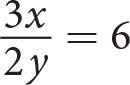 , what is the value of
  ?
?
1. 
2. 
3. 
4. 1
|
x |
y |
|
1 |
|
|
3 |
3 |
|
5 |
|
|
7 |
|


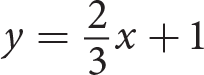
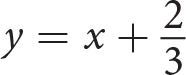
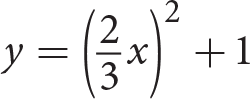
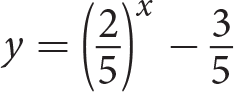
7. Which of the following equations relates y to x according to the values in the table above?
1. 
2. 
3. 
4. 
8. In a restaurant’s kitchen, c cakes are made by adding s cups of sugar to a mix of eggs and butter. If s = 3c + 5, how many more cups of sugar are needed to make one additional cake?
1. 0
2. 
3. 1
4. 3
9. A bowling league charges a one-time membership fee of $25, plus x dollars each month. If a bowler has paid $53 for the first 4 months, including the membership fee, what is the value of x ?
1. 4
2. 7
3. 10
4. 13
10.If x > 0, which of the following is equivalent to 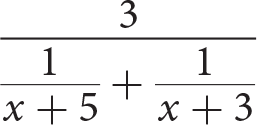 ?
?
1. 
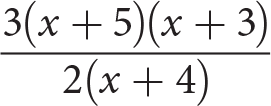
2. 
3. 3(x + 4)
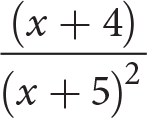
4. 
11.
A Note about Grid-ins
You will see an occasional question without answer choices throughout the Math chapters of this book, starting in the next chapter. On the PSAT, several of these Grid-in questions appear at the end of each Math section. Instead of bubbling in a letter, you’ll enter your responses to these questions into a grid that looks like this:
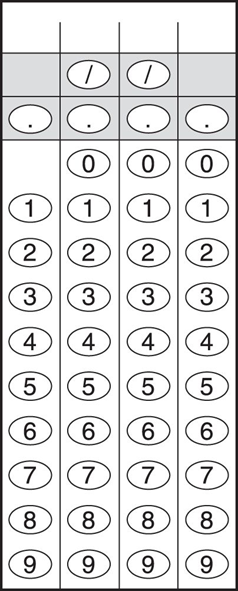
If you are gridding a value that doesn’t take up the whole grid, such as 50, you can enter it anywhere in the grid as long as the digits are consecutive; it doesn’t matter which column you start in. Gridding mixed numbers and decimals requires some care. Anything to the left of the fraction bar will be read as the numerator of a fraction, so you must grid mixed numbers as improper fractions. For instance, say you want to grid the mixed fraction  . If you enter 51/2 into the grid, your answer will be read as
  . Instead, enter your response as 11/2, which will be read (correctly) as
  . Alternatively, you could grid this answer as 5.5.
A repeating decimal can either be rounded or truncated, but it must be entered to as many decimal places as possible. This means it must fill the entire grid. For example, you can grid  as .166 or .167 but not as .16 or .17.
Note that you cannot grid a minus sign or any value larger than 9,999, so if you get an answer that is negative or larger than 9,999 to a grid-in question, you’ve made a mistake and should check your work.
Reflect
Directions: Take a few minutes to recall what you’ve learned and what you’ve been practicing in this chapter. Consider the following questions, jot down your best answer for each one, and then compare your reflections to the expert responses on the following page. Use your level of confidence to determine what to do next.
Think about your current habits when attacking PSAT questions. Are you a strategic test taker? Do you take the time to think through what would be the fastest way to the answer?
Do word problems give you trouble?
What are the steps of the Method for PSAT Math and why is each step important?
EXPERT RESPONSES
Think about your current habits when attacking PSAT questions. Are you a strategic test taker? Do you take the time to think through what would be the fastest way to the answer?
If yes, good for you! If not, we recommend doing questions more than one way whenever possible as part of your PSAT prep. If you can discover now, while you’re still practicing, that Picking Numbers is faster for you on certain types of questions but not on others, you’ll be that much more efficient on test day.
Do word problems give you trouble?
If word problems are difficult for you, get into the habit of taking an inventory, before you do any math, of what the question is asking for and what information you have.
What are the steps of the Method for PSAT Math and why is each step important?
Here are the steps:
1. Step 1. State what the question is asking
2. Step 2. Examine the given information
3. (Taking an inventory is especially important in word problems.)
4. Step 3. Choose your approach
5. (Taking a moment to decide what approach will be the fastest way to the answer will ultimately save you time.)
6. Step 4. Confirm that you answered the right question
7. (Making sure you solved for the right thing will save you from losing points to speed mistakes on questions that you know how to do and should be getting credit for.)
NEXT STEPS
If you answered most questions correctly in the “How Much Have You Learned?” section, and if your responses to the Reflect questions were similar to those of the PSAT expert, then consider the Method for PSAT Math an area of strength and move on to the next chapter. Do keep using the method as you work on the questions in future chapters.
If you don’t yet feel confident, review those parts of this chapter that you have not yet mastered and try the questions you missed again. As always, be sure to review the explanations closely.
Answers and Explanations
1. B
Difficulty: Medium
Category: Radicals
Strategic Advice: Backsolve by plugging the answer choices in for y to determine which one makes the given equation true.
Getting to the Answer: Simplify the equation by subtracting 4 from both sides to get  . Now, check the answer choices, starting with (B) or (C). If the answer you choose is too large or too small, you’ll know which direction to go when testing the next choice.
(B):  . This is the correct answer.
If you prefer the algebraic approach, here it is:
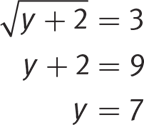
Again, (B) is the correct answer.
2. C
Difficulty: Medium
Category: Solving Equations
Strategic Advice: Break apart the question into its mathematical parts; determine what information you have and what value you need to find and then determine how you’ll find that value.
Getting to the Answer: To answer this question, organize the information you know. The capacity of the trailer is 8,000 pounds. However, equipment that is already on the trailer weighs 1,500 pounds, so there is only 8,000 − 1,500 = 6,500 pounds of remaining capacity. Each container weighs 300 pounds, so divide 6,500 by 300 to determine the maximum number of containers that can be packed:  . Partial containers may not be packed, so round down to 21, which is (C).
3. D
Difficulty: Medium
Category: Solving Equations
Strategic Advice: Begin by determining what you are being asked to find—the difference between the online retailer’s price and the department store’s price. Next, use the information you’re given—the price at the appliance store, as well as fractions that represent the prices at the other two retailers.
Getting to the Answer: To answer this question, determine the price of the vacuum cleaner at each retailer. Online, the vacuum cleaner sells for  of the price at the appliance store, or
  . The department store sells the vacuum cleaner for
  the price of the appliance store, so the department store’s price is
  . Now that you know the price of the vacuum cleaner at each store, simply subtract: 540 − 315 = 235, which is (D).
4. C
Difficulty: Easy
Category: Proportions
Strategic Advice: Because the answer choices are widely spaced apart, and the question asks for the answer that is “closest to the number,” estimation will be a better approach than wading into unnecessarily detailed and tedious calculations.
Getting to the Answer: Notice the relationship between the stack of trays in the question and the stack of trays you are asked to solve for: you are given a stack of  inches, and you are asked how many plates are needed for a 14-inch stack. The number 14 is very close to twice
  , so you will need nearly twice the 50 plates given in the question. Thus, 100 is the correct answer, which is (C).
5. D
Difficulty: Medium
Category: Systems of Linear Equations
Strategic Advice: Use the answer choices to your advantage to quickly find Keith’s distance.
Getting to the Answer: The question gives two unknowns and enough information so that a system of equations could be formed. Traditional algebra could be used to solve this system of equations.
However, there is a more efficient way to answer the question: examine the answer choices to see which answers make sense for Keith’s distance. The question states that Keith ran 18 more miles than Mick; thus, Keith must have run more than half of the 76 miles that the two of them ran. Since one-half of 76 is 38, you can eliminate (A) and (B) immediately.
Now, you just have to check either (C) or (D). For (C), if Keith ran 42 miles, then Mick ran 42 − 18 = 24 miles, and 42 + 24 = 66 miles, which isn’t correct. Thus, (D) is the correct answer. For the record, if Keith ran 47 miles, then Mick ran 47 − 18 = 29 miles, and 47 + 29 = 76, which is correct.
If you are curious about the algebraic approach, let k represent the number of miles Keith ran. Since Keith ran 18 miles more than Mick, Mick ran 18 miles fewer, or k − 18 miles. They ran a combined 76 miles, so the following equation can be created and solved:
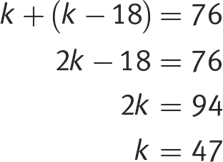
Again, this matches (D).
6. A
Difficulty: Medium
Category: Solving Equations
Strategic Advice: You have two variables, but only one equation, so solving for each variable will not be possible. Instead, pick numbers for x and y that will make the equation true.
Getting to the Answer: Pick a simple number for x and solve for y. Hopefully, y will also be easy to work with so you can plug them into the expression you are trying to find. Say x = 4; this gives 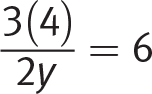 , or
, or 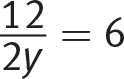 . Multiplying both sides by 2y gives 12 = 12y, so y = 1. Both numbers are very manageable, so plug them into the expression
  . This yields
 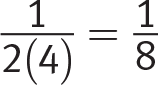 , which is (A).
7. A
Difficulty: Medium
Category: Linear Graphs
Strategic Advice: The answer choices are split into two types. The first two are linear equations and the second two are nonlinear. They are quadratic and exponential, respectively. Thus, examine the table to determine whether the relationship between x and y is linear or nonlinear.
Getting to the Answer: Notice that for every increase of 2 in x, y increases by  . Thus, the relationship is linear, meaning you can eliminate (C) and (D). To determine whether (A) or (B) is correct, substitution could be used. However, note that if y increases by
  for every 2 unit increase in x, then dividing both values by 2 shows that y increases by
  for every 1 unit increase in x. This is the definition of slope, and the only equation that is a line with a slope of
  is (A).
8. D
Difficulty: Medium
Category: Word Problems
Strategic Advice: Pick a number for c to see how many cups of sugar will be needed, then pick another number for c to see how the number of cups of sugar changes.
Getting to the Answer: Pick a number for c; let’s say c = 2. This means that 3(2) + 5 = 11 cups of sugar are needed for two cakes. Now, try c = 3: 3(3) + 5 = 14 cups of sugar needed for 3 cakes. To go from 2 cakes to 3 cakes, 3 additional cups of sugar were needed, which is (D). You can try c = 4 to confirm: 3(4) + 5 = 17, which is another 3 cups of sugar.
9. B
Difficulty: Medium
Category: Word Problems
Strategic Advice: Backsolve by plugging in answer choices for x to determine which answer matches the cost of four months of membership.
Getting to the Answer: Examine the answer choices, starting with (B) or (C). If the answer you choose is too large or too small, you will know which direction to go. Multiply the answer choice by 4 and add the $25 membership fee.
(B): $7 × $4 = $28 → $28 + $25 = $53. This is a match, so (B) is the correct answer.
Algebra could also be used here:
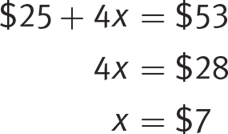
Algebra also leads to $7, which is (B).
10.B
Difficulty: Medium
Category: Rational Expressions and Equations
Strategic Advice: Pick a number for x to determine the numerical value of the given expression, then plug the same number into the answer choices to find the one that matches.
Getting to the Answer: Pick something easy, like x = 1: 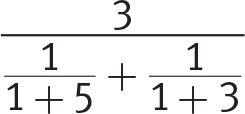 . This simplifies to
 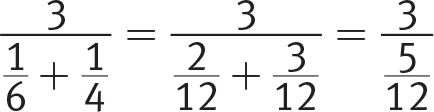 . This fraction can be rewritten as
 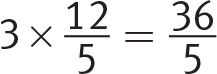 .
.
Now, plug 1 in for x in each of the answer choices to see which one gives you the same value:
(A):  . Eliminate.
(B):  . Correct! Just to be sure, check the other two answers.
(C): 3((1)+4) = 3(5) = 15. Eliminate.
(D): 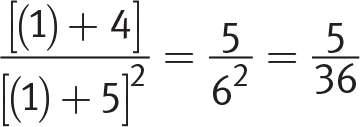 . Eliminate.
Since (B) is the only answer that matched the calculated value, it must be the correct answer.