Practical models for technical communication - Shannon Kelley 2021
Job materials best practices
Job materials
Following a few best practices can make your job materials stand out. Be mindful of how the following elements might impact your audience’s response to your materials. Make documents that are easy to scan, include active verbs, avoid clichés, and point to references who can vouch for your work.
Design for Scanning
Research shows that some employers spend as little as six seconds scanning job materials to determine if you might be the right person for the job.4 Sometimes employers use software to scan job materials for them and identify data points that determine whether the applicant meets the job qualifications (figure 6.13). Once you the attention of an actual person, they are likely to spend five minutes or fewer looking over a résumé. Notice we use the word looking and not reading. Your document’s layout and text must work together to communicate efficiently.
Figure 6.13. Important Résumé Areas. Make good use of the area where the eye tends to concentrate. Place your most recent and relevant experience here.
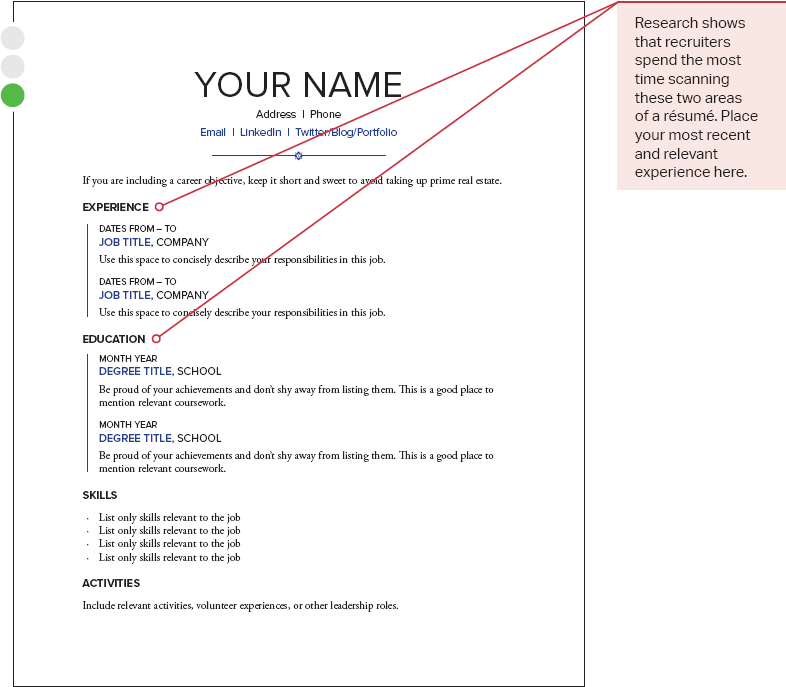
Most employers spend time scanning for these data points:
” Candidate name
” Current position/company/employment dates
” Previous position/company/employment dates
” Education
Recognizing how your audience will scan your document prepares you to design effective and efficient documents. Your job is to keep the eye moving down the entire page and avoid any design elements or white spaces that stall, misdirect, or stop the user’s gaze (figure 6.14).
Figure 6.14. Design for Scanning. This graphic illustrates the way a recruiter’s eye flows over the text. Bullet points and white space direct the eye and keep the user moving down the page.
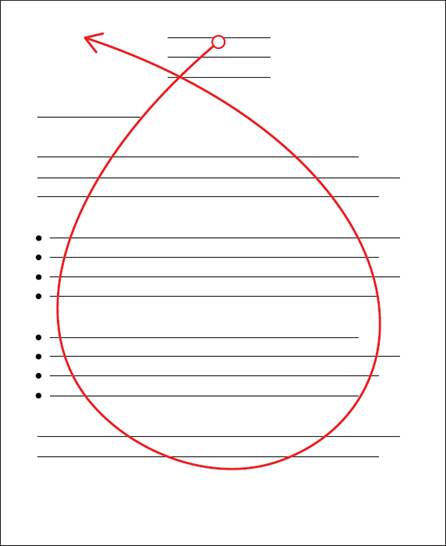
You need to communicate a lot of information in a small amount of space, but extending the margins of your document and creating a wall of text will ensure that your résumé, at best, goes to the bottom of the pile. Too spare of a design can likewise shuffle your résumé to the bottom.
Once a recruiter has determined a candidate possesses the required experience and education, they scan for keywords, specific words or phrases that relate directly to the open position. Some companies use software, such as applicant tracking systems, to filter résumés based on keywords. Resume-reading technology is constantly evolving, so it’s a good idea to stay up to date on current hiring practices and expectations.
Build your vocabulary list of keywords by completing the following:
” Search the job posting for important words that describe the kind of work required for the position.
” Search professional profiles of people who hold similar positions for how they describe their position.
” Search the company’s website and “about us” page for how they describe their work and company culture.
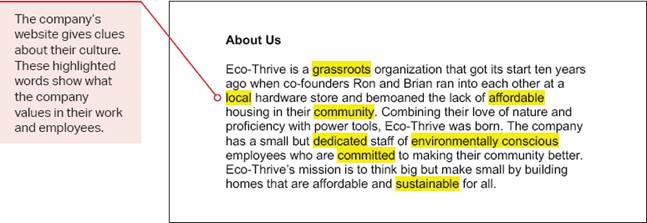
Figures 6.15 and 6.16 show how Connor uses the job posting and the company’s website to define keywords for his job materials. In the first example, the highlighted words provide him with a vocabulary list with which to describe his skills and experience on his résumé. In the second example, Connor uses the highlighted words to tailor his cover letter and show how his interests align with the company’s mission.
Use Accurate Verbs
You can enliven your technical documents by using more accurate verbs. Precise action words convey the importance of what you’ve done in previous roles. For example, if you say that you “worked in sales” at a particular job, it doesn’t sound particularly impressive. Worked can mean many things. On the other hand, if you say that you “managed the sales accounts for forty commercial customers,” the user has a much better impression of your role and responsibilities. Managed tells the employer that you can handle multiple tasks.
Figure 6.15. Keywords in Job Posting. The highlighted words indicate potential keywords in the job posting.
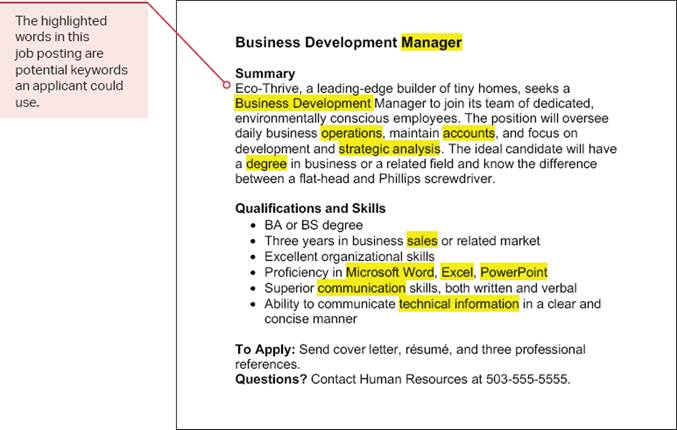
Figure 6.16. Keywords in Employer’s Description. The highlighted words indicate ways to tailor job materials to the specific employer.
On your résumé, use a variety of verbs to convey your past experiences as accurately as possible. Use the past tense, such as “managed,” for past jobs. Use the present tense, such as “manage,” for jobs you still hold. Specific verbs show the employer that you understand what they want. Figure 6.17 provides a useful list of strong verbs to show your experience.
In your cover letter, go one step farther. Provide evidence of your qualifications that is specific and measurable. For example, Connor volunteered with the Green Giants and helped grow its recycling programs by 20 percent. Generalities, such as “I’m a hard worker” or “I have good leadership skills,” tend to fall flat. But statements like “I served as a team leader with the Green Giants for two years” and “We planted 200 new trees in the Columbia River Valley” offer evidence to support his claim. As with any kind of effective writing, a claim should be followed by supporting evidence.
Figure 6.17. Active Verbs for Job Materials. Get more out of the verbs in your job materials. Instead of saying, “I was a manager,” say “I managed.” It’s shorter, more precise, and shows a specific action.
Avoid Clichés
A cliché is a sentence or phrase that is overused and shows a lack of originality. How many times can you hear someone tell you to “make lemonade out of lemons” or that they “love you to the moon and back?” It might be cute, but being cute is not the skill you’re marketing.
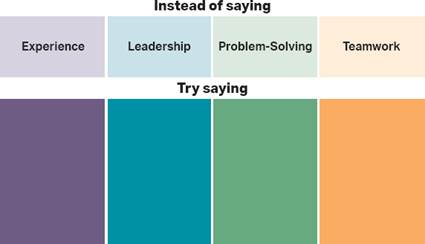
You might think employers want to hear that you’re a leader, excellent at interpersonal communication, and detail oriented, but everyone uses these phrases. Do your research and find the overused phrases in the specific job document you’re completing. Find a different way to convey that information without employing the clichés.
What you need, instead, are keywords. As mentioned earlier, these words are functional rather than descriptive. An example of functional keywords would be to say you are a “social media expert” instead of saying you have “excellent communication skills.” Employers use keywords to find matches, particularly when your materials are part of a database. Saying you are a “strong leader” will lump you in with a ton of other people. This table outlines phrases overused by job seekers (figure 6.18).
Figure 6.18. Effective Word Choice for Job Materials. If you want to stand out, don’t use tired phrases and buzz words.
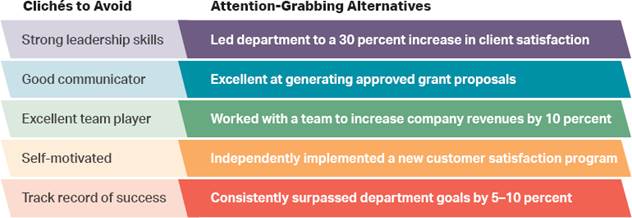
Include specifics when possible as further evidence of your claim. Don’t underestimate the power of details. Anyone can describe themselves using adjectives, but competitive applicants can point to what they’ve done to demonstrate their character and abilities. Even without data to measure your success, specific language builds more credibility with your audience. It also proves that you’re a “good communicator” without you having to say it.
Maintain Strong Connections
Job postings generally ask for three references or recommendations, either as part of the application process or part of the interview. It’s important that you don’t wait until you’re looking for a job to build your bench of supporters who are familiar with your work ethic and abilities. Keep in touch and stay on good terms with previous supervisors and teachers. These contacts are most likely to be able to provide a recommendation.
Connor has already asked two of his current instructors to serve as references. He considered using his uncle as a reference, since Uncle Buck is his current employer and direct supervisor. However, a family member isn’t usually the best, unbiased choice. Besides, Connor’s uncle doesn’t know he is job hunting. So, what should he do?
Most potential employers do not expect you to use your current employer as a reference. Many people look for a new job while they still have one, often without telling their boss. You do not need to jeopardize your current position by sharing this information. Connor can leave his uncle off his reference list without alarming anyone. Instead, he contacts the coach of his swim team, who can speak to his commitment to continuous improvement and his ability to work well with others.